How to Use a Smart Thermostat With a Swamp Cooler
Smart thermostats were built for furnaces and central air. A swamp cooler has a water pump, a blower motor with one or two speeds, and usually a rotary switch on the wall, so a smart thermostat can't run it directly. This guide covers what has to go in between, your options, and what to check before you buy anything.
Updated
Why a smart thermostat can't run a swamp cooler on its own
- Thermostats switch 24-volt control circuits. A cooler's pump and blower run on 120 or 240 volts and draw motor current. Wiring a thermostat straight to them would destroy it and create a shock and fire hazard.
- An evaporative cooler works best when the pads are soaked before air moves. A thermostat only knows “cool on” and “fan on.”
- A typical cooler has a pump, a low speed and a high speed, and the two speeds must never run at the same time.
- Most smart thermostats need continuous 24-volt power, the C-wire. A cooler on a line-voltage wall switch has no 24-volt supply at all.
What sits between the thermostat and the cooler
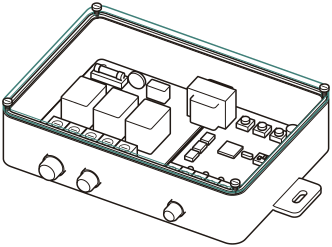
The fix is an interface mounted at the cooler. It does four jobs: it supplies 24-volt power to the thermostat, reads the thermostat's calls for cooling and fan, switches the pump and motor speeds with motor-rated relays, and runs the pump before the blower so the pads are wet first.
Your options
| Option | How it works | Good | Watch out for |
|---|---|---|---|
| Keep the wall switch | A manual rotary switch: OFF, PUMP, LOW, HIGH. | Nothing to buy. | No temperature control, schedules or remote access. |
| Generic 24V relay kit | HVAC relays and a transformer wired at the cooler. | Inexpensive; parts are stocked at supply houses. | You design the wiring yourself, and nothing sequences the pump before the fan. |
| Dedicated cooler controller | A replacement wall control built for evaporative coolers. | Designed around coolers from the start. | You use its controller instead of the thermostat you want. |
| Thermostat adapter (like Monsoon) | A box at the cooler that lets a standard 24V thermostat run it. | Keep any 24V smart thermostat; pre-wet and fan speed are handled for you. | Monsoon is in development, with pre-orders shipping spring 2027. |
How the thermostat terminals map to the cooler
This is how Monsoon reads a standard thermostat. Other adapters and relay kits can map terminals differently.
- R
- 24VAC power from Monsoon's built-in transformer.
- C
- Common, so the smart thermostat stays powered (the C-wire).
- Y1
- Cooling call: the pump starts, the pads pre-wet, then the blower runs on low.
- Y2
- Second-stage call: the blower switches to high.
- G
- Fan only: the blower runs on low with the pump off (vent mode).
Before you buy: a five-point checklist
- 1Read the motor label. One-speed and two-speed motors are straightforward. Variable-speed (ECM) motors need a different approach.
- 2Confirm a separate water pump. Most whole-house coolers have one, with its own lead back to the control box.
- 3Look at what's on the wall now. A line-voltage rotary switch, a basic 24V thermostat and a brand digital controller each convert differently.
- 4Count the conductors in the wall cable. You need four or five: R, C, G and Y1, plus Y2 for two-speed control.
- 5Pick the thermostat, and decide about the furnace. If the same thermostat should also run your furnace in winter, plan the wiring for both from the start.
Safety and permits
Line voltage can kill. Shut off the breaker and the cooler's disconnect, then confirm the power is off before touching any wiring. Cooler work often happens on a roof, so plan for safe footing too.
Paid installation generally requires a licensed contractor across the Southwest. In New Mexico, for example, evaporative cooler work falls under the MM-3 HVAC classification (14.6.6.11 NMAC). Check with your city or county about permits, and confirm that any old cable you reuse for thermostat wiring meets local code.
If you're deciding between a cooler and central air, see swamp cooler vs. air conditioner. For humid weeks, see how to run a cooler in monsoon season.